

Ultrasonic Spray Coating for Energy
Ultrasonic precision spraying coating is a high-performance industrial grade precision spraying technology used for coating sub micron and nanometer level thin films with high uniformity. The applications in the field of energy mainly include battery manufacturing, solar cells, and surface treatment of new energy equipment.
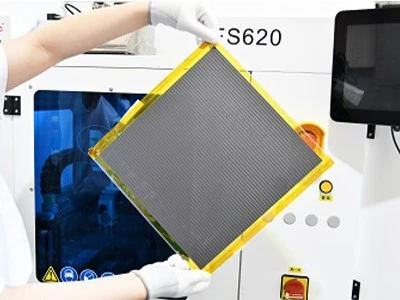
FUNSONIC offers various ultrasonic coating systems, including desktop ultrasonic coating systems FS310, FS620, industrial grade ultrasonic coating systems FS650, FS650X, double-sided automatic flipping ultrasonic coating system FS650Y, equipped with multiple nozzle units and membrane vacuum heating adsorption platform.
Fuel Cell
FUNSONIC's fuel cell catalyst coating systems produce highly durable, uniform coatings of carbon-based catalyst inks for proton exchange membranes (PEMs) in fuel cells and electrolysis processes without deforming the membrane.
Suspensions containing carbon black inks, PTFE binders, ceramic slurries, platinum and other precious metals can be uniformly deposited on the membrane through our spray systems. Other metal alloys, including metal oxide suspensions for platinum, nickel, iridium and Ru-based fuel cell catalyst coatings can also be ultrasonically sprayed to manufacture PEM fuel cells, polymer electrolyte membrane (PEM) electrolyzers, DMFC (direct methanol fuel cell) and SOFC (solid oxide fuel cell).

Electrolyzers
In recent years, hydrogen energy has become increasingly needed as a clean energy source. Hydrogen is produced by electrolysis of water. In hydrogen fuel cell production, ultrasonic coating systems are ideal for spraying carbon-based catalyst inks onto electrolyte membranes.
Double-sided coating is possible, and different catalyst formulations can be coated on each side of the membrane. The durability and repeatability of the coating have been proven to be superior to other coating methods, typically providing higher efficiency and extending the service life of the coated PEM.

Thin Film Solar Cell
Ultrasonic thin film solar coating precision spraying is an advanced process that uses ultrasonic technology to spray solar coatings with high precision. By precisely controlling the spraying amount and coating range of the coating through ultrasonic nozzles, it ensures that the solar coating forms a uniform and dense thin film on the substrate. At the same time, the solar coating can be atomized into nanoscale extremely small particles under the action of ultrasonic waves, improving the light absorption rate and electrical conductivity of the coating, and enhancing the conversion efficiency.
Ultrasonic spraying technology has been proven to successfully deposit thin film solar cell coatings, including anti reflective layers, TCO coatings, buffer coatings, PEDOT, and active layers for thin film and perovskite solar cell manufacturing.
Silicon Solar Cell
Ultrasonic spraying systems provide a low-cost solution for solar panel cell manufacturing. FUNSONIC ultrasonic nozzles uniformly deposit nano-coatings, such as TiO2 and SiO2, to deposit AR anti-reflective thin film coatings on solar cell glass panels to increase the light transmittance of the glass. Another application is the deposition of hydrophilic and hydrophobic coatings on solar panels.

Protective Polyimide Layer
Polyimide coatings play an important role in various fields such as aerospace, automotive, and electronics due to their high hardness, heat resistance, and chemical stability. For example, polyimide coating can enhance the wear resistance and high temperature resistance of high-temperature components such as aircraft engine blades.
Ultrasonic spraying can convert polyimide solution into micrometer sized droplets, forming uniform films ranging from nanometer to micrometer sized. By precisely controlling the thickness and uniformity of the coating, effective results have been achieved in fields such as automotive (batteries, high-temperature components), medical (implantable devices), and electronics (flexible circuits).
