


Ultrasonic Welding Machine
What is Ultrasonic Welding Machine?
Ultrasonic welding is the fastest, most accurate, economical, and effective welding method for thermoplastic materials. A welding equipment that uses ultrasonic energy to generate local high temperatures in the welding area, rapidly melting the surface of thermoplastic materials, and then applying a certain pressure to integrate them into one. Ultrasonic welding is performed in a short period of time, making it incomparable to the method of using adhesives. Due to strong adhesion and clean welding parts, it can reduce costs and improve productivity and quality.




Why Choose Us?
Application Area
Ultrasonic plastic welding machine is mainly used in industry, automotive industry, electronic products, medical industry, etc. Especially in places where permanent, secure, and visually impeccable connections are required. For all ultrasonic equipment, the ultrasonic generator ensures repeatable results, and the welding process is easy to optimize using our specialized controller and appropriate software.
Sales Market
Our products are sold in many countries, including the United States, Canada, Russia, South Korea, Indonesia, Colombia, Germany, Poland, South Africa, the Netherlands, Hungary, France, Vietnam, Bulgaria, the United Kingdom, Mexico, and the United Arab Emirates and so on. Our main customers are agents experienced in ultrasound technology and end users..
Our Products
FUNSONIC specializes in developing and manufacturing ultrasonic equipment. Our product line includes ultrasonic spray coating machines, ultrasonic nozzle spray shaping machines, ultrasonic welding equipment, ultrasonic cutting equipment, ultrasonic liquid processing equipment, ultrasonic low-melt metal treatment. We also offer a variety of ultrasonic core components.
Our Team
Hangzhou FUNSONIC Ultrasonic Company was founded in 2018, led by multiple experts with over 10 years of practical experience in the field of high-power ultrasonic. The team members are mainly born in the 1980s and 1990s, all of whom have a college degree or above. Has strong competitiveness and challenge, used for innovation, responsibility, and accountability.
Advantages of Ultrasonic Welding Machine
Rapid and Efficient Joining Process
Ultrasonic welding machine offers remarkable speed and efficiency, allowing for high-speed production. With cycle times typically taking seconds to complete, this technique boosts productivity and shortens assembly times. By utilizing high-frequency vibrations that generate frictional heat, ultrasonic welding enables rapid melting and bonding of plastic parts.
Strong and Durable Welds
One of the remarkable characteristics of ultrasonic welding is the strength and reliability of the joints it produces. Through molecular-level fusion between plastic parts, ultrasonic welding creates welds that exhibit strength comparable to the base material. These welds demonstrate exceptional resistance to tension, shear, and peel forces, making them ideal for demanding applications in industries such as aerospace and automotive.
Versatility and Compatibility with Various Materials
Ultrasonic welding machine is highly compatible with a wide range of thermoplastic materials. It can successfully join both similar and dissimilar materials, including rigid and semi-rigid plastics. Furthermore, the process accommodates various material thicknesses and shapes, offering flexibility for diverse design requirements.
Non-Contact and Clean Joining Method
As a non-contact joining technique, ultrasonic welding eliminates the need for additional consumables or adhesives. This characteristic not only simplifies the process but also ensures a clean and aesthetically pleasing finish. The absence of adhesives removes the risk of contamination, making ultrasonic welding an attractive choice for applications with stringent cleanliness requirements. Additionally, the process generates minimal waste, aligning with sustainable and eco-friendly manufacturing practices.
Cost-Effective Solution
Ultrasonic welding machine provides cost savings in multiple aspects of the manufacturing process. By eliminating the need for additional fasteners, adhesives, or connectors, this technique reduces material and labor costs. Moreover, the fast cycle times and high productivity associated with ultrasonic welding contribute to increased throughput and overall cost efficiency, making it an economically viable option.
Application of Ultrasonic Welding Machine
Welding of Electronic Products
The assembly of electronic products is carried out using ultrasonic welding technology, which includes the welding of the internal components of the electronic products and the connection between the electronic products. In the process of ultrasonic welding, the ultrasonic wave heats the surface of the weldment to reach a certain temperature, so that the weldment is plastically deformed, so as to realize the connection between materials. At the same time, after the welding is completed, a high-strength nugget will be formed in the weld area, which improves the product performance.
Welding in the Auto Parts Industry
Products in the automotive manufacturing industry are made from a variety of materials, often with several different welding methods. Ultrasonic welding is an efficient and high-quality welding method that has been used in various products, especially in automobile parts, such as automobile plastic interior parts, exterior parts, wiring harnesses, etc. In the automotive industry, ultrasonic welding has become a promising welding process. Ultrasonic welding machine is a piece of equipment that can be widely used in various industrial products.
Welding of Home Appliances
Ultrasonic welding is also widely used in home appliances. In air conditioners, ultrasonic welding technology is used to improve its thermal insulation performance. In addition, ultrasonic welding is also widely used in household appliances such as vacuum cleaners, electric fans, refrigerators, washing machines, etc. The welding quality of household appliances can be greatly improved by using ultrasonic welding methods. Ultrasonic welding has a great advantage, that is, it does not require any external auxiliary devices, and the connection is made through the pressure generated by the workpiece itself. This method can reduce heat loss during the welding process. In addition, ultrasonic welding technology is widely used in home appliances because it can better prevent damage to parts caused by stress concentration.
Welding of Medical Products
Ultrasonic welding machines can also be used for welding medical products, including disposable medical equipment and appliances, medical and household household equipment. The use of ultrasonic welding can reduce the manufacturing cost of medical products by 30%-50%, while also improving the quality and production efficiency of medical devices. Medical products such as medical syringes and infusion sets can be realized by ultrasonic welding.
Main Parts of Ultrasonic Welding Machine


Generator
The generator converts electrical power with a resonance frequency to the required voltage and high frequency. In addition, it has a microprocessor responsible for driving the welding cycle and providing important welding communication through the user interface.
Machine Press
The machine press holds the welded system and applies the force that holds the welded joint together. It has a pressure gauge and regulator, allowing the operator to adjust the force exerted on the system.
Welding Stack
The welding stack comprises the transducer, booster, and welding horn mounted on the welding machine press at the booster’s central point. It is responsible for providing ultrasonic machine vibration, and its frequency must be close to the generator’s frequency for quality welded joints.
Transducer
A transducer or converter converts high-frequency electrical energy to mechanical vibration. It comprises several piezoelectric ceramic discs placed between two titanium blocks. Also, an electrode is made from a thin metal plate between the piezoelectric discs.
Booster
The booster has two functions. First, it amplifies the produced vibration by contracting and expanding and transmits them to the welding horn. Second, it acts as a base for the welding stack on the welding press.
Welding Horn
The welding horn is responsible for transmitting the vibration to the welded part. It is made of aluminum or titanium. However, aluminum is only suitable for low-volume applications because it wears out. To reduce the wear out, most welding horn has hardened tips.
Support Tooling
The support tooling functions in holding the machine’s lower component during welding. It is the base of the machine designed to match the contours of the workpieces.
How Does an Ultrasonic Welding Machine Control Heat?
Amplitude, frequency and wavelength
In ultrasonic welding, longitudinal waves are transmitted at high frequencies, producing low-amplitude mechanical vibrations. The electrical energy of the welding machine is converted into mechanical energy. In order to understand the relationship between amplitude, frequency, and wavelength, and how they relate to heat production, we need to look at the main components of an ultrasonic welding machine. The main components of an ultrasonic welding machine are a power generator, transducer, booster, and welding horn. The power generator converts 50–60Hz, 120V/240V power to 1300V power running at 20–40Khz. This energy is supplied to a transducer, which uses a disk-shaped piezoelectric ceramic to convert electrical energy into mechanical vibrations.
Heating Rate
For the same material, three factors determine the heating rate: frequency, amplitude, and welding pressure. For existing equipment, such as 15Khz, 20Khz, 30Khz, or 40Khz machines, the frequency is fixed. So the heating rate can usually be changed with the welding pressure. Generally, the greater the pressure, the faster the heating rate. In addition, you can also change the amplitude. Like the pressure, the greater the amplitude, the faster the heating rate. Of course, excessive pressure and amplitude will also have adverse effects on welding quality, such as material degradation, cracks, and flash. Therefore, ultrasonic welding requires a process of process parameter optimization. After the parameters are determined, the welding process can achieve a stable output with fast speed and high welding strength. This is why ultrasonic welding is widely used in mass production.
Time, Distance, Power and Energy
The amount of heat required for welding depends on the material type, weld design, and equipment specifications. The traditional method of controlling heat is to weld via a time pattern. However, today’s ultrasonic welding equipment can often also set and monitor welding distance, power, and energy. Properly trained operators can also adjust parameters according to actual conditions and different materials to obtain consistent welding results. This also greatly improves the flexibility and reliability of welding.
During the ultr asonic welding process, welding parameters will affect the welding results. These parameters include amplitude, welding distance, welding pressure, welding energy and trigger pressure.
Different types of plastic require different amplitudes. The amplitude can be fine-tuned through the percentage settings in the software, or a wide range of adjustments can be made by replacing amplitude modulators with different ratios. Welding pressure can be adjusted via a knob or software settings. Trigger pressure means that after the welding head presses the product, when the pressure reaches a certain set value, the device starts to emit ultrasonic waves. This value can be adjusted through the knob or software settings.
In fact, there are multiple control modes for the operation of ultrasonic welding equipment. Normally, it is divided into two types: time mode and energy mode.
One is the simple and commonly used mode is the time mode, which sets the duration of the ultrasonic weld without considering other parameters. Another commonly used mode is the energy mode, which sets the energy of the welding. This mode usually requires a microprocessor-based controller to measure and record the energy input during the welding process and calculate the energy (the integral of the energy over the entire time ). In this mode, the ultrasonic vibration always stops when the energy of the piece is reached or the displacement is large. In power mode, when the instantaneous power exceeds the preset power, the ultrasonic vibration stops.
There is also a distance welding mode (position mode) that sets the distance or position of welding. Used to control the final dimensions of the weldment, the ultrasonic mold stops when in contact with the fixture. The welding of different products is suitable for different welding modes. For example, energy welding mode is used for sheet welding, distance welding mode is used for products with large dimensional tolerances, and position welding mode is used for products with height tolerance requirements.
Precautions for the Use of Ultrasonic Welding Machines
The output power of the ultrasonic welding machine should be measured
The output power of the ultrasonic plastic welding machine depends on the diameter, thickness, material and design process of the piezoelectric ceramic wafer. Once the ultrasonic sensor is formed, the maximum power is determined. The ultrasonic generator developed by Das Technology can accurately track the power of each welding, helping production to be reviewed in a timely manner and reducing the defective rate.
Ultrasonic welding parameters need to be evaluated
The output power, vibration frequency, amplitude range and other issues should be considered according to the workpiece material, welding line area, whether there are electronic components in the workpiece, whether it is sealed, etc.
The structure of the ultrasonic welding horn needs to be rigorously inspected
Conventional ultrasonic mold manufacturers have a set of strict inspection procedures, and the processing dimensions are simulated and verified by computer software to ensure quality. These processes are generally impossible to achieve. If there is no reasonable design and mold, the reaction problem will not be obvious in the welding of small workpieces, and various defects will appear with high power. In severe cases, the power components are directly damaged.
How Does Ultrasonic Welding Machine Work
An Ultrasonic welder is a machine that uses kinetic energy from vibrations to heat and melt plastic together. The basic process comes down to a vibration frequency, measured in hertz, directing energy onto a section of the 2 parts you want to weld together.
This often gives a better bond than glue as the part, is heated to it’s melting point, then pressed into one another. The melted plastic then must harden and set, joining the 2 parts together. The benefits of this process are that it’s made without additional adhesives, screws or soldering materials to bind the parts together. This simplifies the assembly process and usually the weld provides a better seal and is as strong as the other methods.
The parts that are being welded are placed between the nest (commonly known as the anvil) and the sonotrode (commonly known as the horn). Both the horn and the nest is usually made from aluminium or titanium. The sonotrode is the connected to a transducer which emits the acoustic vibration. This vibration flows from the transducer, down the horn, and onto the part that is being welded. The frequency of the vibration can range from 15kHz all the way up to 70kHz.
The part design is usually critically. That part that contacts the horn, usually has a triangular lip that is protruding from the face that is being welded. The other part, that is contact with the nest, is held still and has a small groove that meets the protruding lip on the other part. The energy is concentrated into this lip, which is then heated and melted by the vibrations, and at a certain point this lips’ structure collapses and fills the groove with molten plastic.
Ultrasonic welding is usually highly automated, however there can be ultrasonic welding presses that are hand loaded. The usual components of any basic ultrasonic welder are a converter or piezoelectric transducer, which creates the vibrations from electricity. This vibration is usually amplified mechanically using a booster. The vibration is directed onto the target parts using a horn and anvil. There is also controller unit, controlling the movement of the press which can be pneumatically or electrically driven up and down, to clamp the parts together once the weld has become molten. The whole unit is powered by a power supply, which also generates the power for the transducer at the correct frequency.
The mechanical appearance of cleaning and maintenance
If it has not been used for more than one week, please cover it with a dust jacket (plastic bag). When not in use for a long time, please wipe the appearance of the machine, oil up, and cover the attached machine cover, and put it in a dry and ventilated place. Every time the welder is used for one month, the sliding part should be cleaned and reapplied with high-quality grease. Except for the lubricating oil that has been collected by the lifting screw, no oil is required in other parts. The top of the control box should be touched every month, and the dust in the box should be cleaned with a clean, air-free air gun to keep the parts in good condition.


The precautions during operation Maintenance methods
During operation (loaded state), the vibrating table should not exceed the red zone (when the standard welding machine is used). If the indication is exceeded, reduce the pressure, reduce the number of output segments, and adjust the sound wave adjustment. Press the ultrasonic check switch to press it intermittently. Do not press it for more than three seconds to maintain the vibrator life. The vibrator and the vibration machine of the ultrasonic welding machine have high-voltage lines. Do not perform maintenance in the machine except for external operation adjustment. When transporting the machine, the vibration box should be separated from the body (disassemble the cable socket), and care should be taken not to be hit.
Tips for Ultrasonic Welding Machine Troubleshooting
Overweld is when the resulting weld is more extensive than is specified. Overwelds can result in functional and aesthetic problems, altering the dimensions, finish and functionality of the part.
Problems: Overwelding often occurs because of excess energy that leeches outside of the intended area, affecting surfaces that are not intended to be welded.
Solutions: The best way to reduce overweld is to reduce the amount of energy applied to the part. This can be done through the following means:
● Reduce the pressure, trigger force and down speed used to reduce overall energy input.
● Reduce the overall amount of time put into the weld.
● Reduce the amplitude produced by the ultrasonic welder by changing to a lower ratio booster, digitally reducing the amplitude percentage, using amplitude profiling or using a lower gain horn.
● Reduce the absolute distance by recalibrating the absolute distance and adjusting it accordingly.
● When correcting an overweld, it is important to adjust each parameter individually rather than adjust them all simultaneously. You may also consider making sizeable parameter changes of 20 to 30 percent to induce opposite failure. This way, you can more easily gauge the efficacy of the change and work to find an optimal setting.
An underweld is the opposite of an overweld — in these cases, the weld has not covered the entire area needed, so some areas are left untouched. This causes serious functional issues, as the part is not welded together strongly enough to meet specifications.
Problems: Underwelds most often occur for the opposite reason as overwelds — instead of too much energy being put into the part, too little energy is being put in. Additionally, underwelds may be caused by improper setup or cleaning.
Solutions: Underweld is easily fixed with small adjustments in procedure and welder settings. This can be accomplished through the following steps:
● Check all parts before welding to ensure that they are clean and free of moisture.
● Recalibrate the base of the welder to ensure that it is level and makes full contact with the attachment before welding.
● If energy is being lost into the fixture, change the fixture to a rigid material like aluminum or stainless steel.
● Increase the pressure, trigger force or down speed to increase the energy applied to the part.
● Increase the amount of time the weld is applied.
● Increase amplitude by using a higher ratio booster or changing to a higher gain horn.
● Increase the absolute distance.
Non-uniform welds are both aesthetically unappealing and can have functional drawbacks. Non-uniform welds are not as strong in some areas as in others, meaning that the part may have a low-quality seal.
Problems: Faulty parts or fixtures most often cause non-uniform welds around the joint.
Solutions: Non-uniform joint welds are most often fixed with simple part, equipment and setup testing and adjustment. Common solutions include:
● Check the part for any signs of manufacturing error or warping. This may include checking the part’s dimensions and molding conditions for any inconsistencies. If the part is not made to specification, tighten tolerances and check molding conditions to ensure that parts are made correctly. If wall flexure is occurring, consider increasing wall thickness, adding internal ribs or modifying the fixture to prevent it.
● Check the parts for any signs of mold release or moisture. If there is any evidence of improperly cleaned parts, update cleaning protocols appropriately.
● Check the setup to ensure that parts are properly aligned before and during welding. Keep an eye out for proper alignment of mating parts and any shifting during the welding process.
● Check the part for signs that filler is accumulating in one area over another. If this is an issue, make sure that you are using short fiber fillers and reduce the amount of filler used.
● Check the setup to make sure that the fixture is firm and that the horn is making uniform contact with the part. If the setup is not right, shim the fixture as needed and test for parallelism.
● If the fixture is insufficiently supported, you may want to either improve support or, in especially bad cases, change to a rigid fixture.
● If the problem may be the horn, have the horn tested and modified or repaired to produce a uniform amplitude.
Our Certifications

Our Factory
FUNSONIC was established In 2018. It is composed of several engineers with more than 20 years of practical experience in the field of high-power ultrasound. FUNSONIC focus on the development and manufacture of ultrasonic equipment, such as ultrasonic spray coating machine,ultrasonic nozzle spray shaping machine, ultrasonic welding equipment, ultrasonic cutting equipment, ultrasonic liquid processing equipment, various kinds of ultrasonic core components. Also we will provide customized services according to the needs of our customers.


Ultimate FAQ Guide to Ultrasonic Welding Machine
Hangzhou Shengtu Technology Co., Ltd. is one of the most professional ultrasonic welding machine manufacturers and suppliers in China, featured by quality products and low price. Please rest assured to buy ultrasonic welding machine for sale here from our factory. Also, customized service is available.
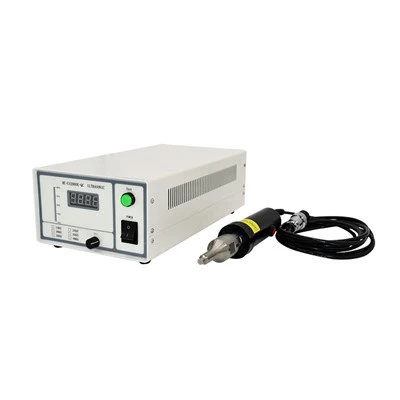
35Khz Ultrasound Portable Cylinder Spot Welder, Ultrasonic Riveting Handpistol Plastic Welding Device, High Power Ultrasonic Technology For Hand Cream Plastic Tube Sealing