

What are the Applications of Ultrasound Sonochemistry in Medicine?

Ultrasound can be used in chemistry to increase reaction rate and product yield. The majority of the impact of ultrasound on chemical reactions is due to cavitation: the formation and rupture of small bubbles in solvents. In this review, we first provide an overview of the physical background of cavitation and discuss its dependence on factors such as sound intensity and frequency, solvent, and temperature. The influence of ultrasound on chemical reactions is considered for both homogeneous and heterogeneous liquid-solid systems. The first field is mainly illustrated by discussing the impact of ultrasound on polymerization and depolymerization reactions, while the second field is illustrated through selected examples in organic synthesis. We also briefly discussed the trend of ultrasound changing the reaction mechanism to support the homogeneous (rather than heterogeneous) pathway. The specific preference for a specific path under sonochemical conditions is different from the path under mechanical stirring, and is called "sonochemical conversion". We compared the ultrasonic equipment used for laboratory scale experiments and provided some practical tips and traps.
Ultrasound fragmentation and cell lysis
Ultrasonic sonochemical equipment is mainly used for sample preparation and production. These fields particularly include homogenization, emulsification, and suspension of various substances, as well as acceleration of chemical reactions, cell fragmentation, and extraction of cell contents. The use of ultrasonic sonochemical equipment can selectively destroy certain substances, shorten the tedious preparation process, and improve the yield of many reactions. Comparison with mechanical processing equipment such as planetary ball mills, rotors/stators, or gap homogenizers shows that ultrasonic sonochemical equipment works with higher efficiency, especially making reproducible results possible. The trend of analysis is that the sample size is getting smaller and the use of chemicals is also decreasing. For example, in recent years, the use of ultrasonic sonochemical equipment has become crucial, as even the smallest sample size requires fast, economical, and repeatable processing.
Destruction of cells and microorganisms
In modern laboratories, ultrasonic sonochemical equipment is used to destroy cell walls to extract cell contents, such as proteins, without damaging them. A portion of the energy introduced into the cell suspension is converted into heat through friction. In order to avoid thermal damage to the cell contents, the sample is either subjected to intermittent ultrasonic treatment periodically or cooled in a cooling container during ultrasonic treatment. The rose pond can perform uniform ultrasonic treatment on microorganisms, as the ultrasonic energy forces the sample to circulate repeatedly below the probe and throughout the entire side arm. Placed in an ice bath, due to the expansion of the glass surface, it can effectively cool the contents.
The destruction of cell membranes largely depends on the elasticity of the cells. Cellular components, such as mitochondria or cytoplasm, can be partially disrupted by altering input ultrasound energy and extraction power. For particularly resistant bacteria (such as streptococci), fungi, spores, yeast, or tissue samples, direct destruction can be achieved through micro tips with very high ultrasound amplitudes, as micro tips can input a very large amount of energy into the smallest sample size.
When using microliters, foam and splash in the container are a bigger problem. May cause valuable loss of sample materials. Therefore, power regulation is very important. If you want to destroy cells with unstable walls, only a small amount of power or amplitude is needed. In order to continuously dissolve in large quantities, a special flow container made of glass or stainless steel with an ultrasonic chamber is used to treat each particle of the suspension with the same strength. If the container is additionally equipped with a cooling jacket, thermal damage to the cell contents can be ruled out. To avoid contamination from foreign particles, such as erosive particles from the probe, indirect ultrasonic treatment is preferred in a cup booster or cup horn. This method achieves uniform strength and cooling.
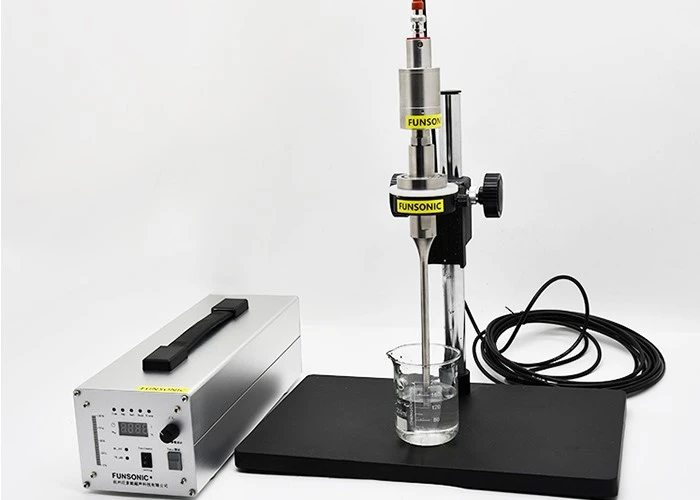
Applications in Biochemistry and Medicine:
1. Destruction of organizational culture
Subcellular components and viruses are destroyed without any damage.
2. Parent child identification
Quickly extract matrix free hemolytic substances from the EDTA blood of the assumed father for parent-child identification (reducing preparation time by approximately 30 minutes).
3. Urology
Biochemical membrane analysis of sperm components.
4. Genetic research
Extract DNA from human body materials.
5. Lipid preparation
The use of ultrasound (20 kHz) to decompose MLV (multilayer liposomes) is the main method for producing SLV (monolayer liposomes).
6. Treatment of smallpox vaccine
Prepare a uniformly distributed infection solution.
Dispersed
With the help of ultrasonic energy, solid particles or even liquids can be dispersed into another carrier. Nanoscale powders, such as titanium dioxide or pyrolysis silica, are increasingly used in the production and testing of paints and paints, as well as in the polishing of small car body surfaces due to their large specific surface area and increasing reaction potential. In addition, these substances have an adverse tendency towards aggregation, resulting in decreased fluidity and wettability. The formed agglomerates are destroyed by ultrasonic homogenizer and the dispersion is permanently stable to prevent re aggregation.
In particle size analysis, dispersion is crucial for the measurement process. Particles can only be identified during the measurement process, and they appear as detectable measurement signals in the measurement area. Therefore, undispersed agglomerates result in significant measurement errors. With the help of ultrasound, particles are subdivided to prepare for subsequent measurements.
When ultrasonic emulsification is used, two immiscible liquids such as oil and water are processed into quasi homogeneous lotion. Compared with traditional methods using rotors, ultrasound can produce finely dispersed lotion with very small droplet size and very high stability. Neither the formation of clumps or clusters nor the settling of droplets occurs. When using traditional methods such as rotors or mixers, slow stirring often leads to liquid separation. Mixing too quickly can lead to unwanted air inclusions. Ultrasonic homogenizers are commonly used in pharmacies for high-quality small-scale production of ointments.
In our daily life, we will encounter many different forms of ultrasonic homogenized lotion, such as in cosmetics or lotion.
Homogenization
The application scope of ultrasonic homogenization technology ranges from the production of paint and varnish to the homogenization of wastewater and soil samples for analytical purposes, and then to sample preparation for particle size analysis. Especially for industrial wastewater, it is necessary to continuously check for the presence of heavy metals, fats, or oils in environmental laboratories in order to take immediate measures when the concentration exceeds the standard. For representative analysis results, it is necessary to convert the wastewater sample into a homogeneous state. This is achieved through ultrasonic homogenization with high reliability in a very short period of time.
In order to characterize the landfill potential and pollutant assessment of waste samples, such as PAH (polycyclic aromatic hydrocarbons), heavy metals, or MKW (mineral oil hydrocarbons) in soil, ultrasonic extraction is used as a rapid homogenization process as an alternative method for elution.
In agriculture, ultrasonic homogenizers are used for sample preparation to subsequently determine the THC content in cannabis and the PAH concentration in vegetable foods (such as strawberries) based on soil load.
Ultrasonic homogenizers are often used for food quality control. In order to meet the limit values, the nitrate content of cheese must be measured in the laboratory. The previous method of using xylenol methanol distillation and subsequent photometry was very problematic in toxicology and particularly time-consuming. Therefore, in order to quantitatively determine the nitrate content or mechanically pre crush the cheese. Then, in a short period of time, dense and fine homogenization was carried out in the rose node cells using ultrasound. The achievable particle size is less than 1 μ m, and since aggregation formation does not occur, it greatly promotes subsequent filtration to quantitatively wash out ions.


