


Products


120Khz Ultrasonic Fuel Cell Spraying Coating Gathering Together Nozzle
Item No: FSW-1203-L
Frequency: 120khz
Power: 1-15w
Continuous spraying amount(max): 0.5-10ml/min
Effective spraying width: 2-20mm
Spray uniformity: ≥95%
Solution viscosity: ≤30cps
Atomized particle size range : 15-40μm
Hangzhou Shengtu Technology Co., Ltd. is one of the leading manufacturers and suppliers of 120khz ultrasonic fuel cell spraying coating gathering together nozzle in China. Welcome to buy high quality customized products at low price from our factory. Contact us for more details.
120Khz Ultrasonic Fuel Cell Spraying Coating Gathering Together Nozzle is an ultrasonic atomizing nozzle with small spray width (2-20mm) . The ultrasonic atomization nozzle technology is adopted, and the special contraction flow channel design will uniformly and centrally distribute the carrier gas, so that the ultrasonic atomized liquid mist is in the form of concentrated spray, thus reducing the spray area of the ultrasonic nozzle. Due to the small spraying width of the centralized ultrasonic nozzle, it is mainly suitable for various small and medium-sized spraying applications, complementing FUNSONIC FocusMist spraying ultrasonic nozzle, and can be almost suitable for all different flat spraying requirements.
advantages
1. The coating is ultra-thin and uniformly applied, with controllable droplet size of 5-30 μ m and soft atomization without high pressure impact. It can accurately prepare 2-8 μ m ultra-thin catalytic layers
2. The utilization rate of the slurry is extremely high, with no high-pressure overspray or rebound splashing caused by ultrasound. The utilization rate of the slurry is 92% to 97%, reducing the loss of Pt/C precious metals
3. The microstructure of the catalytic layer is excellent, the formed pore structure is reasonable, the three-phase interface is rich, and the Pt utilization rate is improved
4. Low temperature and mild film formation, no high pressure impact to damage proton membranes, improved mass production yield, indirectly reducing unit platinum consumption

Four core anti sedimentation technologies of ultrasonic spraying


Applications

Anionic Membrane Spraying

Carbon Paper Spraying

Solar Cell Spraying

MEA

PEM

Proton Exchange Membrane for Fuel Cells
Why choose us
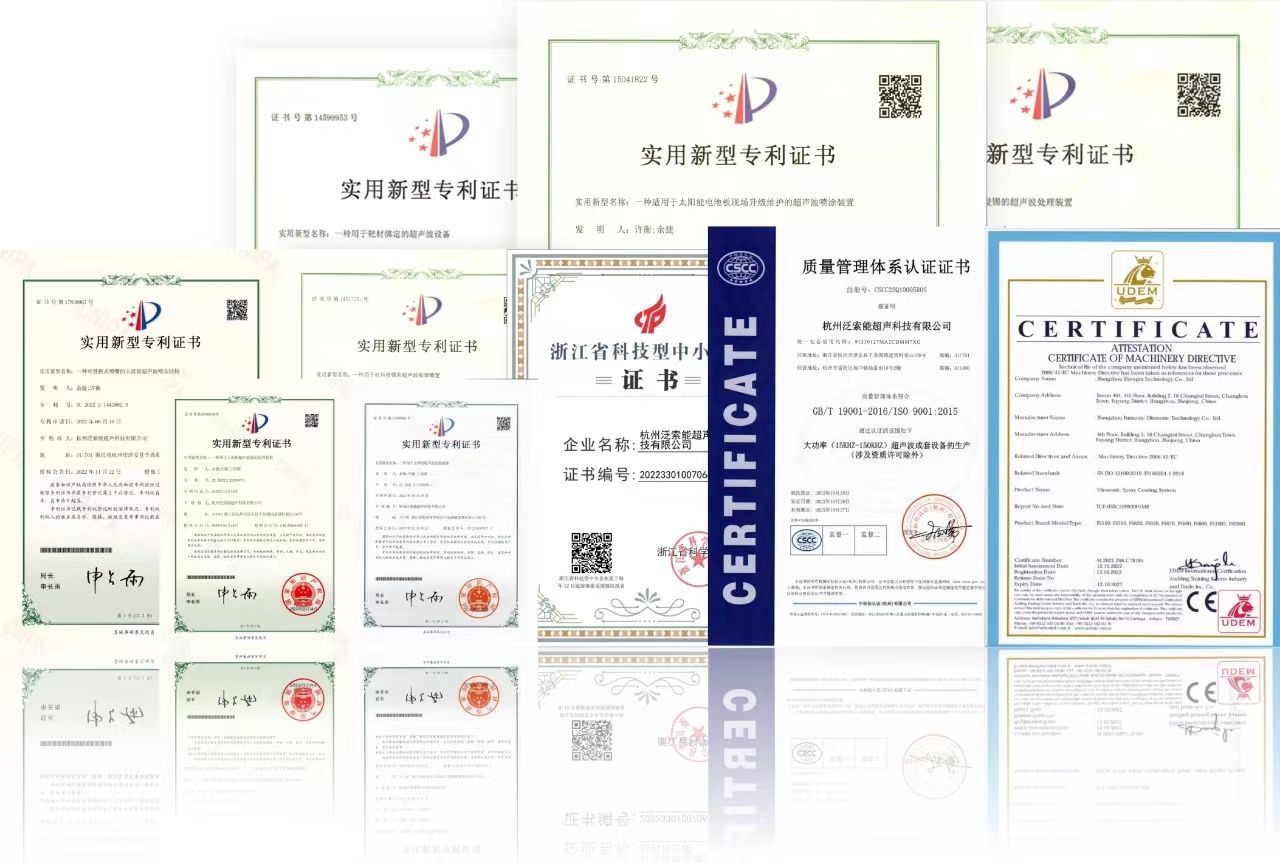
At FUNSONIC, the equipment we produce is closely related to advanced manufacturing technology. That's why companies in various fields such as precision spraying, sonochemistry, melt treatment, precision welding, or cutting come to us when they need new equipment.
We have over 20 years of experience in collaborating with advanced enterprises and universities in various industries. We can specify, design, procure, and install perfect ultrasonic equipment for almost any application. Continue reading to learn more about us and contact us immediately to ask questions or request a quote for your business.
FAQ
Q: What is the effect of solution viscosity on nozzle frequency during ultrasonic spraying?
A: High-frequency nozzles are typically used for low-viscosity coatings. This is because high-frequency vibration generates greater shear force, enabling effective dispersion and spraying of low-viscosity coatings. Conversely, applying excessively high frequencies to high-viscosity coatings may cause the material to exit the nozzle too rapidly, leading to inadequate dispersion.
Q: What is the effect of solution viscosity on amplitude?
A: The setting of amplitude is also closely related to the viscosity of the coating. For high-viscosity coatings, it is generally necessary to increase the amplitude. High-amplitude vibration can deliver higher energy, facilitating the dispersion and spraying of high-viscosity coatings. Conversely, excessive amplitude for low-viscosity coatings may lead to over-dispersion or loss of control during spraying.
Q: What is the reason for the easy precipitation of Pt/C (platinum carbon) slurry?
A: Pt/C (platinum carbon) slurry is the core raw material of PEM catalytic layer, with a Pt particle density of ≈ 21.4g/cm ³ and a carbon carrier XC-72 of ≈ 1.8g/cm ³. The solid-liquid density difference is extremely large, and it is prone to gravity settling according to Stokes' law.
Q: What is the effect of Pt/C slurry settling on PEM membrane?
A: The settling of Pt/C (platinum carbon) slurry directly causes fluctuations in the platinum loading of the catalytic layer, imbalance of the three-phase interface, deterioration of single-cell consistency, and waste of platinum raw materials
Hot Tags: 120Khz Ultrasonic Fuel Cell Spraying Coating Gathering Together Nozzle, China 120Khz Ultrasonic Fuel Cell Spraying Coating Gathering Together Nozzle manufacturers, suppliers, factory, Ultrasonic Application Float Glass Wide Spraying Nozzle, High Uniformity Ultrasonic Spray Nozzles No Clogging Coating, Ultrasonic Eddy Current Spray Coated Nozzles, Line Spray Focused Ultrasonic Atomizer Nozzle For Antiplatelet Drug Coating, 40Khz Probe Type Ultrasonic Spray Coating Nozzle, 120Khz Low Power Ultrasonic Spray Nozzle Coating Technology
| Model | FSW-1203-L |
| Type | 120Khz Ultrasonic FocusMist Spraying Nozzle |
| Frequency | 120Khz |
| Power |
15w |
| Atomized Particle Size Range (µm) | 15-40 |
| Spray Width (mm) | 2-20mm |
| Spray Flow (ml/min) | 0.5-10 |
| Spray Height (mm) | 10-30 |
| Liquid Viscosity (cps) | <30 |
| Particle Size (µm) | <10 |
| Diversion Pressure (Mpa) | <0.05 |
| Application | Suitable for brackets, balloon conduits, flux for selective welding application, PEM, MEA etc |
You Might Also Like
 Learn More
110khz Cyclone Cone Shaped Ultrasonic Spray
 Learn More
High Frequency 120khz Ultrasonic Atomization Nozzles
 Learn More
100Khz Drug Stent Ultrasonic Atomizing Spraying Nozzle
 Learn More
Fully Automatic Internal Pipe Coating Ultrasonic Noz...
 Learn More
Vacuum Blood Collection Tube Coating 60khz Ultrasoni...
 Learn More
50Khz Ultrasonic Wide Type Spray Coating Nozzle
Send Inquiry
