
Introduction:
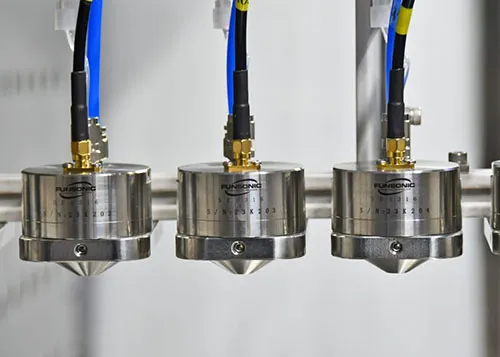
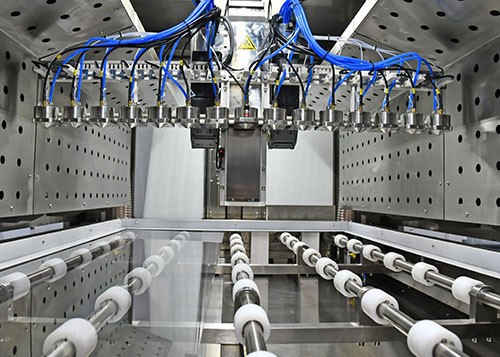
Due to the excessive use of release agents in traditional spraying methods, defects during the demolding process can affect product quality. However, using ultrasonic spraying can greatly reduce these defects. The ultrasonic nozzle used in injection molding demolding coating applications is usually integrated onto a robotic arm platform to achieve fully automated processes. These critical coatings make the cured parts easy to separate from the mold during production and protect the mold during extensive injection cycles. The ultrasonic spraying system for injection molding release coating agent can be easily integrated with the injection molding machine to cope with challenging demolding applications.
Principle:
There are two theoretical explanations for the principle. They are respectively micro shock wave theory and surface tension wave theory.
On the one hand, the theory of micro shock waves explains the cavitation effect of ultrasound in liquid media, which leads to the generation and atomization of micro shock waves. This theory suggests that cavitation effect is the direct cause of liquid atomization. When a cavitation bubble ruptures, except for thermal and optical radiation, all other radiation occurs in the form of micro shock waves. When the micro shock wave reaches a certain intensity, it will cause liquid atomization. When the micro shock wave reaches a certain intensity, it will cause liquid atomization.
On the other hand, surface tension theory suggests that the generation of droplets is due to the instability of liquid surface waves, which causes the atomization of the liquid. Specifically, when a specific sound intensity of ultrasonic waves passes through a liquid, surface tension is formed by the ultrasonic waves at the gas-liquid interface. Once the vibration surface reaches a certain amplitude value at this interface, the force is perpendicular to the surface tension, and the peak of the liquid water droplet flying out forms fogging. This theory suggests that surface tension waves generate droplets at their peak, and the droplet size is proportional to the wavelength.
- Improve productivity.
- The cycle time is reduced.
- Improve the surface quality of the product
- Reduce waste rate.
- Provide minimal accumulation on molds and tools.
- Reduce (minimum) pinholes.
- Improved the flow characteristics of mold release because the drop is very small
- Improve the service life of molds
- Affects maintenance cycle (reduces the frequency of maintenance cycle)
- Reduce defects.
- Reduce the consumption of release agent by 50% -75%.

The ultrasonic spraying system for injection molding release coating agent is easily integrated with mold injection molding machines to challenge release applications. It is an ideal design for complex geometries and closely spaced molds. In order to adapt to products of different sizes and shapes, different spray shape designs can be used (vortex nozzles are usually used in these applications).